

Lending teams are facing a rapidly shifting landscape. While consumer demand for credit remains strong, the way those consumers expect to be served has changed dramatically.
Today’s borrowers compare their banking experience not just to the financial institution down the road, but to Amazon’s one-click checkout and Netflix’s personalized recommendations. Speed, convenience, and personalization have become the baseline for trust.
At the same time, traditional growth tactics—like siloed cross-sell campaigns or relying on post-application property data—fall short in a digital-first world.
The result? Delayed decisions, missed opportunities, and lost wallet share to faster-moving competitors.
Looking to the future
The lending landscape holds enormous opportunities. With the rise of AI, automation, and better data infrastructure, financial institutions can finally close the gap between consumer expectations and lending execution.
The winners over the next 3–5 years will be those who move beyond the “application layer” (online banking widgets and front-end tools) and into the “infrastructure layer”—owning their data, synthesizing it, and acting on it in real time.
For lending teams, this shift means:
-
Anticipating borrower needs before an application is submitted.
-
Equipping loan officers, marketers, and digital teams with the same real-time property intelligence.
-
Turning previously siloed datasets into actionable insights that drive both efficiency and growth.
The opportunity is to stop playing catch-up and start setting the pace.
The opportunities ahead
1. Moving beyond traditional cross-sell
The days of relying solely on branch interactions, relationship managers, or one-size-fits-all cross-sell offers are gone. Consumer behavior has shifted: Nearly two-thirds (65%) of borrowers who recently applied for a loan did so digitally.1 If your strategy depends on in-person office hours, you’re already missing out.
Key Takeaway: Lending growth requires breaking down silos and meeting borrowers where they are—online, after hours, and on their terms.
The days of relying solely on branch interactions,
relationship managers, or one-size-fits-all
cross-sell offers are gone.
2. From the application layer to the infrastructure layer
For the last decade, most banks and credit unions have focused on adding applications and tools on top of their core systems. While useful, these add-ons don’t solve the deeper challenge: fragmented, inaccessible data.
The next wave of growth will come from mastering the infrastructure layer—owning your institution’s data, analyzing it, and delivering insights back into the customer journey. This isn’t about building more widgets. It’s about building the foundation that makes those widgets smarter.
Key Takeaway: Infrastructure—not just applications—will separate the winners from the laggards.
3. Unlocking the power of real estate data
Real estate lending represents one of the largest opportunities for most financial institutions, yet property data is still treated like a back-office function. Traditionally, lenders only access valuations, ownership details, and equity information after an application has been filed.
But what if lending teams, marketing departments, and digital channels could all tap into real-time property intelligence before the borrower ever applies?
With access to property records, valuations, equity positions, and even competitive loan data, lending teams can:
-
Identify qualified homeowners in their portfolio.
-
Proactively surface refinance or HELOC opportunities.
-
Deliver personalized, pre-qualified offers across marketing, digital, and branch channels.
Key Takeaway: Bringing property data upstream—before applications—unlocks a new level of proactive lending growth.
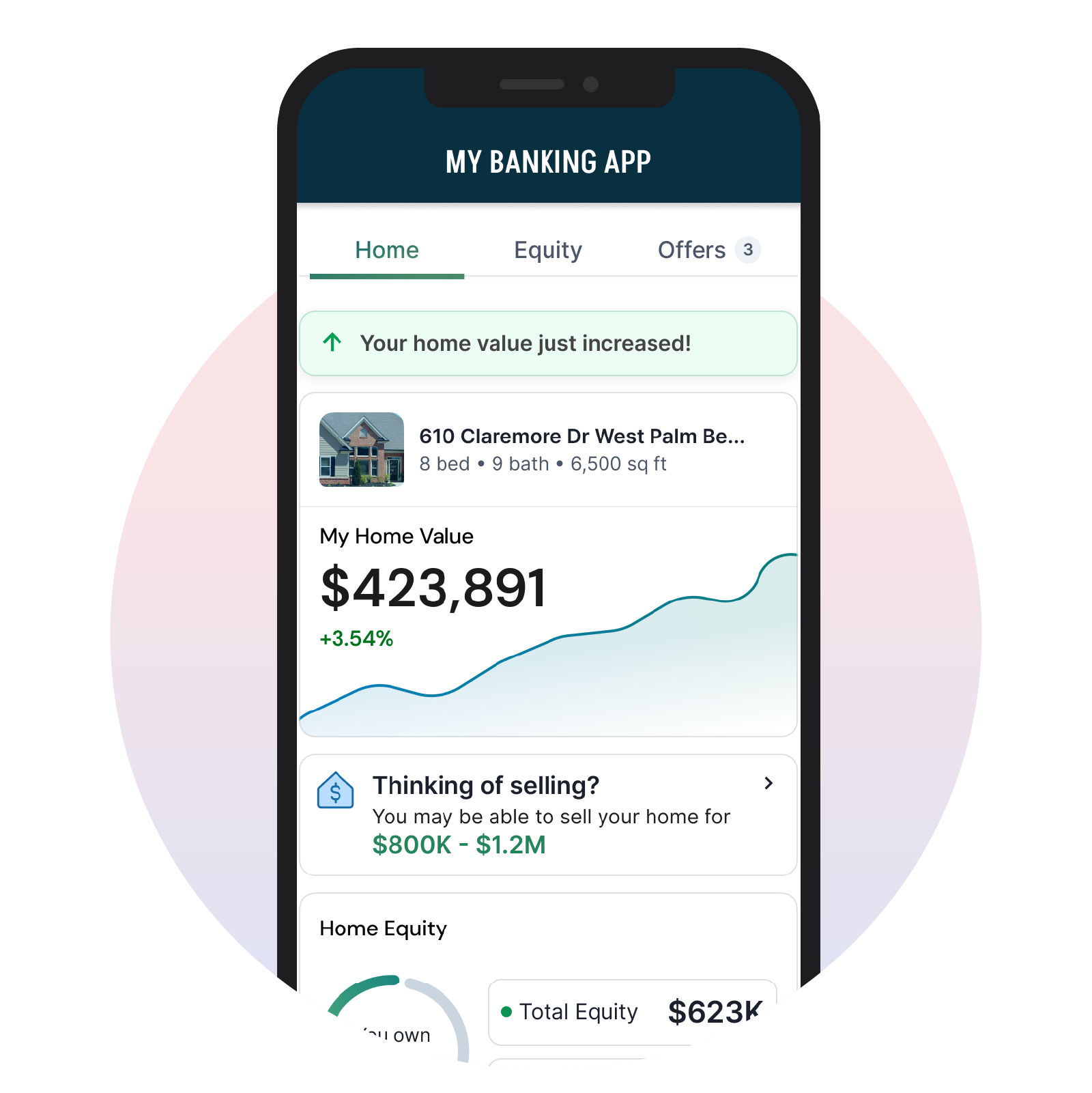
Turn property intelligence into proactive growth
4. Breaking down silos across teams
The traditional lending process mirrors organizational silos: marketing generates leads, loan officers process applications, digital teams manage online channels, and servicing teams take over later. The result is duplicated efforts, inconsistent messaging, and missed opportunities.
By unifying data and making it accessible across teams, institutions can ensure everyone—from digital to marketing to lending—is working off the same playbook.
Key Takeaway: Shared data builds shared growth.
5. Preparing for an AI-Powered Future
AI is still in its early stages—it will never be this “slow” again. The value of AI is directly tied to the quality of the data it can access. For lending teams, this means that preparing for a tech-driven future starts with building a complete, unified, and accessible dataset today.
Institutions that embrace this shift will not only improve efficiency and speed but also unlock entirely new ways to grow their balance sheet.
Key Takeaway: The data you feed today will determine your competitive edge tomorrow.
Conclusion: Building lending growth that lasts
Fintechs have shown what’s possible when consumer expectations are met with convenience and intelligence. But financial institutions have an advantage fintechs can’t replicate: trusted relationships and community roots.
When paired with modern data infrastructure, AI, and real-time property intelligence, that advantage becomes transformative. The time to act is now.



1 Yahoo! Finance: More Consumers Are Filling Out Loan Applications Digitally
Disclaimer: Array takes pride in ensuring the information we share is accurate and up-to-date; however, we understand that the information you read may differ from the product(s) and/or service(s) mentioned. We present the product(s) and/or service(s) you read about without warranty. We recommend you review the product and/or services’ terms and conditions before you make a decision. If you encounter inaccurate or outdated information, let us know by writing to: info@array.com.
Editorial Note: This content is the author’s opinion, expression, and/or recommendation(s).

Chase Neinken is a fintech entrepreneur and digital banking leader focused on transforming how financial institutions engage homeowners.As co-founder and former CRO of Chimney — an award-winning fintech recently acquired by Array — Chase helped pioneer the integration of real-time home values directly into digital banking apps, helping institutions turn property data into deeper, more meaningful member relationships.