

Today, more than 100 million Americans – almost a third of the population – pay rent.1 And as home ownership and housing costs continue to rise, that number likely won’t decrease any time soon.
Further, rent payments are typically a renter’s largest and most consistent financial obligation. The average renter spends about one-third of their income on rent, making it a foundational part of their monthly budget.2
Despite this consistency, the way rent is paid varies widely across the population. A renter’s experience is largely shaped by who they rent from:
-
Roughly 30% rent through large property management companies, which typically offer standardized systems and structured payment processes3
-
The remaining 70% rent from private landlords or smaller property managers, many of whom rely on manual or informal payment methods with less standardized infrastructure3
This means that any solution that is designed for the way rent is paid (independent versus large property management companies) inherently excludes a majority of renters.
At the same time, there’s a fundamental disconnect in the financial system: Even though rent is often a renter’s largest and most reliable monthly payment, it has historically not been reflected in their credit profile.
Renters are seven times more likely to be credit-invisible than homeowners,4 yet their largest recurring payment often goes unrecognized. By not receiving credit for these consistent payments, many face greater barriers to accessing loans and advancing their financial future.
Increasingly, renters want their positive financial behavior to count toward establishing or strengthening credit scores.
That’s exactly why rent reporting has gained traction in recent years.
The rise of rent reporting
80% of U.S. renters want their on-time rent payments to count toward their credit scores (Fannie Mae), and rental properties across America are seeing growing interest in rent reporting.
According to TransUnion’s 2025 Rent Payment Reporting Survey, the percentage of renters with their payments reported to credit bureaus rose to 13% in 2025, up from 11% in 2024 – a meaningful jump that signals growing awareness and adoption.
While still a relatively small portion of total renters, it highlights a broader shift: More renters are actively seeking ways to turn everyday payments into credit-building opportunities.
80% of U.S. renters want their
on-time rent payments to count
towards their credit score.
Interestingly, participation among property managers has declined slightly – from 48% in 2024 to 44% in 2025 – even as consumer participation continues to rise. This suggests a shift toward consumer-driven reporting, where renters are increasingly turning to third-party solutions to report their payments independently rather than relying solely on landlords or property managers.
In other words, demand is no longer dependent on supply; renters themselves are pushing the category forward. And they demand a flexible system that works for them.
Why flexibility in rent reporting matters most
As interest expands and adoption grows, it’s clear that not all rent reporting solutions are created equal. The difference between a tool that succeeds and one that struggles is flexibility.
Rent reporting must work for all renters
We’ve established that 70% of renters rent from independent landlords or smaller property managers. However, many legacy solutions are built around property management systems and companies, automatically excluding this majority.
A modern solution must support both those paying individual landlords and those paying through property management portals to ensure that all renters have access to this powerful credit-building tool.
Solutions designed for broad accessibility can serve 100% of renters – not just the subset tied to large management companies.
This inclusivity is critical. Without it, rent reporting risks becoming another fragmented financial tool rather than a universal solution.
Bring flexible rent reporting to your users
It should only help – not hurt
Rent reporting can be intimidating because of potential downside risk. One missed payment can negatively impact credit scores, harming the very thing renters are trying to improve.
Flexible solutions with positive-only rent reporting remove that fear by:
-
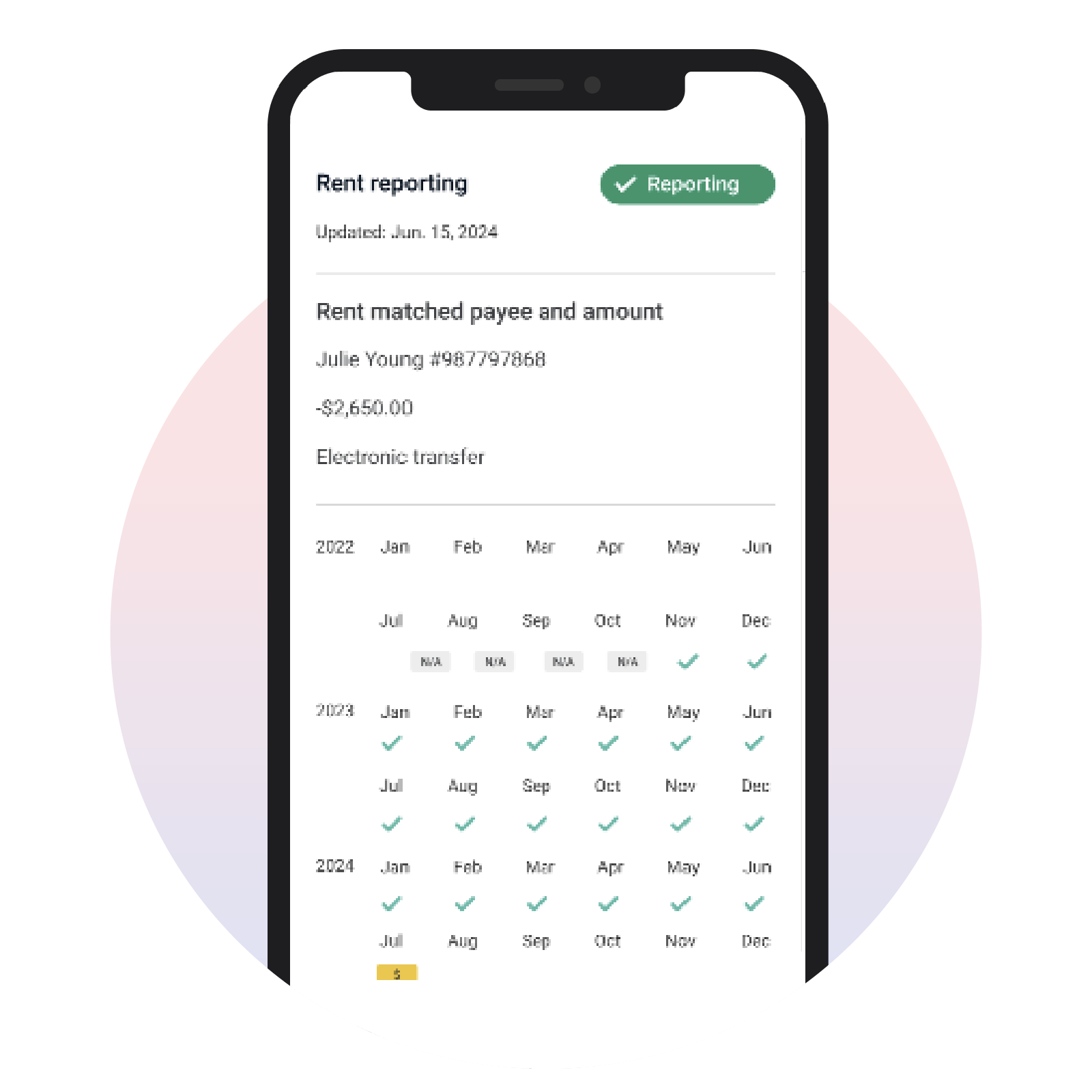
Reporting only positive, on-time payments
-
Avoiding negative reporting when life gets in the way
This positive-only approach increases trust and adoption by ensuring the tool is aligned with the renter’s best interest.
In practice, this can be the difference between a renter participating or opting out entirely.
Inclusivity is critical to making rent reporting
a universal solution that can serve all renters.
Sign up must be as frictionless as possible
Nothing destroys adoption like a complicated enrollment process.
The best solutions keep things simple. They:
-
Provide intuitive, user-friendly onboarding to guide users through the process
-
Eliminate unnecessary documentation requirements where possible
-
Take as much of the burden off the renter and landlord as possible
Reducing friction directly impacts conversion and engagement. A smoother onboarding experience leads to higher activation rates and better long-term retention.
Flexible data sourcing is critical
Rent data doesn’t live in only one place.
Best-in-class solutions support multiple data pathways:
-
Secure account linking via open banking and aggregation
-
Direct integrations with partner platforms via APIs
-
Consumer-provided transaction data
With higher coverage and more inclusivity, this flexibility ensures systems can get the data they need – wherever it may exist.
Further, it future-proofs the solution, allowing it to adapt as payment behaviors, financial ecosystems, and renters themselves evolve.
Trust plays a huge role
Rent reporting can feel risky or unfamiliar. Who wants to submit their private transaction data to yet another platform?
That’s why distribution matters:
-
Renters are far more likely to adopt tools offered within platforms they already trust
-
Embedding rent reporting into existing financial experiences increases confidence, engagement, and trust in the platform
Trust is a primary driver of user behavior, and this represents an opportunity to deepen that relationship and support users in a new, helpful way.
Flexibility is the foundation
of successful rent reporting.
Rent reporting — reimagined
Flexibility is the foundation of successful rent reporting. Solutions that serve all renters, prioritize positive outcomes, and reduce friction are the ones that will define the future of rent reporting.
Array’s rent reporting solution was built with this exact philosophy in mind. BuildCredit Rent was designed to make rent reporting:
-
Accessible to all renters
-
Safe through positive-only reporting
-
Seamless through flexible data sourcing and simple onboarding
-
Easy to deploy within existing platforms as a trusted, embedded experience
By combining these capabilities, it transforms rent from a monthly expense into a meaningful credit-building tool – without adding complexity or risk.



1 Self.com Rent Statistics; 2 USAFacts; 3 Ownership of the U.S. Rental Housing Stock by Investor Type, Congress.gov; 4 Experian
Disclaimer: Array takes pride in ensuring the information we share is accurate and up-to-date; however, we understand that the information you read may differ from the product(s) and/or service(s) mentioned. We present the product(s) and/or service(s) you read about without warranty. We recommend you review the product and/or services’ terms and conditions before you make a decision. If you encounter inaccurate or outdated information, let us know by writing to: info@array.com.
Editorial Note: This content is the author’s opinion, expression, and/or recommendation(s).

Cody Sandell is a Principal Product Manager at Array, focused on building and scaling credit-building solutions for fintechs and financial institutions. With 9+ years in banking, specializing in credit, and over a decade in fintech, he brings deep expertise across financial products and ecosystems.
With a background in product strategy, payments infrastructure, and partnerships, Cody specializes in bringing 0–1 products to market that balance user experience, compliance, and business growth.
With a background in product strategy, payments infrastructure, and partnerships, Cody specializes in bringing 0–1 products to market that balance user experience, compliance, and business growth.